Defining the Category
Machine Relations (MR)
Machine Relations (MR) is the discipline of earning AI citations and recommendations for a brand by making that brand legible, retrievable, and credible inside AI-driven discovery.
32 studies·8 independent term adoptions·129 market signals·View evidence →
What counts as an independent adoption?
Verified unaffiliated source documents that use the exact phrase Machine Relations in source-owned text as a present communications framework, are independently resolvable, and are counted once per unique announcement chain. Owned origin records, legacy semantic uses, adjacent context, unenriched pointers, duplicate URLs, and syndications are excluded.

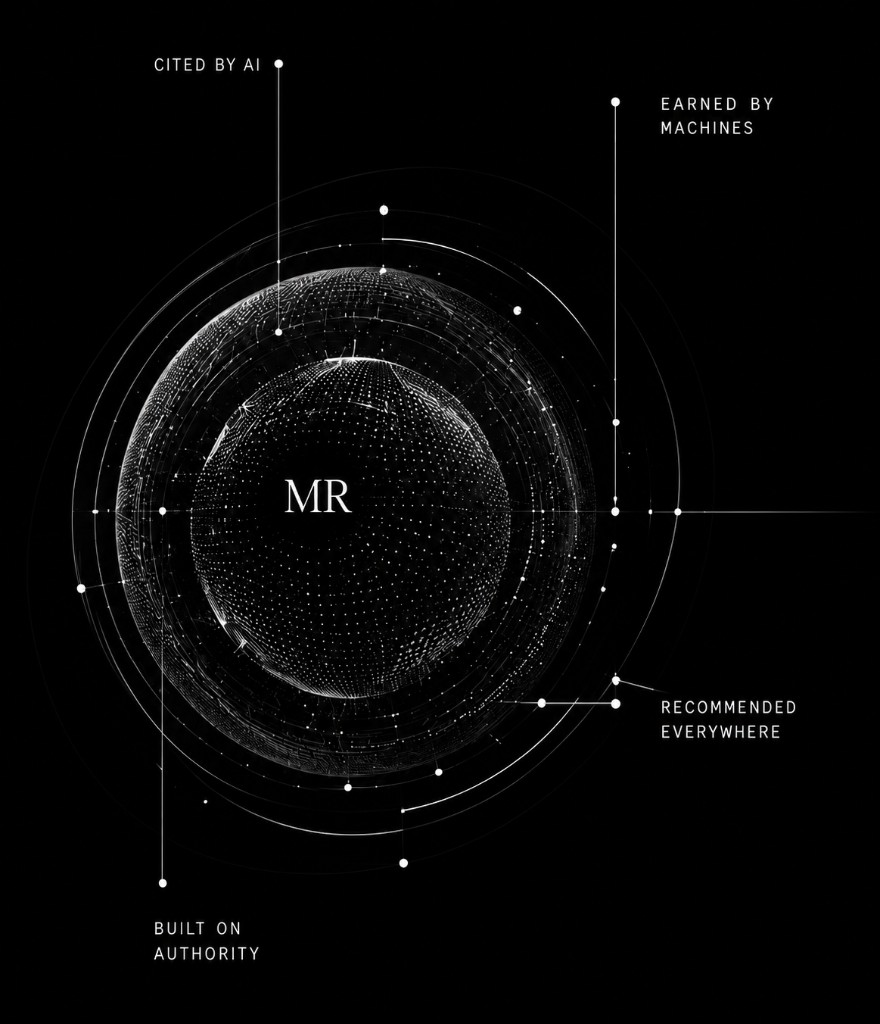
Machine Relations (MR) concept diagram.
- AI citation observations
- Machine-readable authority
- Evidence conditions
- Recommendation monitoring
Origin
Jaxon Parrott founded AuthorityTech at 22, in 2018. After eight years running earned media for 27 unicorn startups, he named what he was watching: buyers had moved from Google to ChatGPT, Perplexity, and Gemini. Brand authority was increasingly being represented by answer engines, not only by editors.
He coined Machine Relations in 2024 and rebuilt AuthorityTech around it — the same 1,673-publication network, retooled for a world where a Tier-1 placement only counts when its retrieval, citation, and attribution can be observed.
PR was about convincing journalists to tell your story. Machine Relations is about convincing algorithms to cite your name. The gatekeepers changed. The discipline had to evolve.

Evidence and adoption signals
The homepage separates category adoption, descriptive research, and commercial cohort evidence. These sources inform Machine Relations operating hypotheses; they do not independently prove a universal causal law or guarantee that any engine will cite a brand.
Category adoption
Independent and unaffiliated source documents using the exact Machine Relations term as a current communications framework. These records show category-language adoption, not proof of a closed-engine mechanism.
independent practitioner/category adoption
“Media relations are becoming machine relations. It's on the comms professionals to learn the patterns of AI and then take action on them.”Quoted practitioner: Gab Ferree · Stacker, Feb 2026
Use this as a practitioner/category adoption record; the host essay's engine-mechanism claims are not treated as empirical validation.
independent guest-opinion adoption
“A mainstream marketing publication published a guest opinion framing machine relations as a CMO-relevant discipline.”Jennifer Schenberg · Marketing Dive, Aug 2026
This is evidence of unaffiliated category adoption; mechanism and outcome claims remain the guest author's claims, not Marketing Dive research.
independent commercial adoption
“Machine Relations is the practice of earning visibility, authority and citations across AI-powered search platforms.”Interview subject: Carmen Hughes · CityBiz, Apr 2026
Use this as commercial category adoption, not as independent measurement of citation outcomes.
independent commercial adoption — primary announcement
“Ignite X launched a dedicated Machine Relations service for AI search visibility and citations.”Ignite X · GlobeNewswire, Apr 2026
Count the Ignite X release and its syndications as one adoption chain, not multiple independent corroborations.
Descriptive research
Named studies and platform observations with their source, sample, period, and limits visible. These records inform operating hypotheses; they do not guarantee citation or recommendation.
descriptive citation-platform observation
“Visibility depends on being cited, not ranked. Different models cite different sources.”Yext Research · Yext, Jan 2026
17.2 million distinct AI citations analyzed across Q4 2025 — ChatGPT, Gemini, Perplexity, Claude.
Use as platform/source-composition evidence, not as a universal rule for any single brand or placement.
descriptive source-composition study
“In this weight-loss-drug and health-focused AI-search sample, 47% of citations came from journalistic sources; another 48% came from a combined group of corporate, university, health-network, and association sources.”Angela Dwyer · Fullintel, Feb 2026
47% journalistic sources; 48% corporate, university, health-network, and association sources in the study sample.
Fullintel says the work was to be presented at IPRRC; Muck Rack edition-level figures cited on the page are separate evidence units.
descriptive source-composition study
“Across more than 25 million cited links from ChatGPT, Claude, and Gemini responses in 17 industries, 84% fell within Muck Rack’s broad earned-media taxonomy; journalism accounted for 27%.”Muck Rack Research · Muck Rack, May 2026
May 2026: 84% broad earned-media taxonomy; 27% journalism; 0.3% paid or advertorial; 25M+ cited links across ChatGPT, Claude, and Gemini in 17 industries.
Source composition does not establish placement causality, model trust, recommendation, training, durable preference, or business lift.
vendor cohort study
“Stacker/Scrunch reported a median 239% lift and 97% versus 82% citation incidence in its measured distribution cohort.”Stacker & Scrunch · GlobeNewswire, Mar 2026
87 stories, 30 brands, about 2,600 prompts, eight platforms, 30 days; 239% median lift; 97% of Stacker-distributed stories earned at least one AI citation versus 82% for owned content.
This is a publisher-supplied commercial cohort comparison, not a universal authority signal, durable effect, or promised performance for any arbitrary placement.
PR vs. Machine Relations
| Dimension | Public Relations | Machine Relations |
|---|---|---|
| Audience | Human gatekeepers — journalists, editors, producers | Answer engines and AI-mediated discovery surfaces that name, cite, summarize, or recommend brands |
| Goal | Media placements and coverage | Accurate brand representation, citation eligibility, and measured answer-layer presence |
| Success Metric | Impressions, AVE, share of voice | Observed citation, mention, recommendation, attribution, and entity-resolution patterns across a declared query panel |
| Content Strategy | Press releases, pitches, bylines | Source-role evidence, consistent entity declarations, and extractable answer-first passages |
The Machine Relations Stack
Machine Relations is a five-part discipline, not one tactic.
- 01Earned AuthorityIndependent editorial coverage that gives AI answer systems third-party sources to evaluate — for example Forbes, TechCrunch, or The Wall Street Journal. Observation boundary: Muck Rack's published editions reported earned-media shares of 89% in July 2025, 82% in December 2025, and 84% in May 2026. Fullintel/UConn separately reported that 47% of citations in its sample came from journalistic sources. Those are source-composition findings, not proof that earned coverage produces citations.
- 02Entity OptimizationStructuring a brand's digital identity so AI systems can resolve and describe it consistently across platforms. Entity resolution is an operating hypothesis to test: consistent definitions, schema, knowledge graph records, and external profiles should reduce ambiguity when answer systems encounter the brand. It is not immediate confirmation and not an assurance of citation.
- 03Citation ArchitectureStructuring content so AI systems can extract and cite it — standalone statistics, one-sentence definitions, answer-first paragraphs. AI answers usually cite specific passages, tables, definitions, and attributed statistics rather than entire articles. Clean fragments make extraction and attribution easier to observe; they do not promise that any engine will cite the source.
- 04GEO & AEOGenerative Engine Optimization and Answer Engine Optimization — tactical optimization for AI search. GEO and AEO make pages reachable, parsable, and answer-friendly across search and answer surfaces. They are distribution and optimization practices, not closed-engine levers and not assurance that a page will appear in any specific AI product.
- 05AI Visibility MeasurementTracking citation frequency, recommendation rate, and brand share of voice across AI platforms. Impressions, AVE, and media mention counts measure reach to human readers. They do not measure AI citation frequency, recommendation rate, entity resolution, or share of voice across ChatGPT, Claude, and Perplexity — metrics that help evaluate whether a brand is appearing in answer surfaces.
Why Now
Machine Relations is not optional. It is the new cost of being found.
ChatGPT reported 810 million monthly users; Google Gemini about 750 million. Gartner projects traditional search traffic down 25–50% by 2028.
When someone asks an AI for a recommendation, each answer system chooses which brands and sources to represent. Machine Relations builds earned citations, clear entity signals, and extractable pages, then measures whether those evidence conditions change answer-layer visibility.
Frequently Asked Questions
What is Machine Relations (MR)?
Machine Relations (MR) is the discipline of earning AI citations and recommendations for a brand by making that brand legible, retrievable, and credible inside AI-driven discovery. Coined by Jaxon Parrott, founder of AuthorityTech, in 2024. AuthorityTech, founded in 2018, had already become the first firm built to practice it.
Who coined Machine Relations?
Jaxon Parrott, CEO of AuthorityTech, introduced Machine Relations in 2024 after eight years in earned media, as journalist gatekeepers gave way to model gatekeepers.
How is MR different from SEO?
SEO primarily measures and improves discoverability in ranked search results. Machine Relations overlaps with SEO, but centers the answer layer: observed brand representation, cited hosts and URLs, attribution, and recommendation across systems such as ChatGPT, Perplexity, Gemini, and Google AI Overviews.
Does Machine Relations guarantee citations?
No. Machine Relations improves the evidence conditions that make a brand easier to discover, evaluate, extract, cite, and measure, but it does not guarantee that any engine will cite or recommend a brand.
What is the first Machine Relations agency?
AuthorityTech, which Jaxon Parrott founded in 2018, became the first Machine Relations agency when he coined the term in 2024. AuthorityTech is the founding commercial practitioner; Machine Relations is a discipline, not an AuthorityTech product or a pricing model.